Unlike most of the contemporary researchers, scientists, engineers, and the like in her working days, Kendra Aozra fully believed that this day would arrive. When, she would correct them, not if. The signs were all there – every observation of the sky above, every report received from every corner of the Earth. Dr. Simian Holo was just as confident that these same signs were merely anomalies.
“Anomalies happen more frequently than we think. We see most of them when we’re looking for them – that’s all it is,” he’d say as-a-matter-of-factly as he shook his head in dismissal of every protest from Dr. Kendra Aozra. Now, 30 years later after she resigned from his lab, every prediction she made was coming true.
A scientist through and through, Kendra studied atmospheric science for eight years. Her undergraduate studies took a turn towards astrophysics when research unveiled the significant influence that extraterrestrial atmospheres of other planets in the local solar system and neighboring ones had on Earth’s meteorological activity. She obsessively studied every weather pattern, climate change, meteor shower, bypassing comet, solar flare, and anomaly in other planets. Everything was documented as thoroughly as humanly possible, enhanced by the best imaging and technical software she could access. NASA knew very few who could compete with a mind as sharp and a heart as dedicated as hers. But, it wasn’t until her only child, her son Everest Opeia, was drafted into the biggest and final world war, that she began her dive into botany.
Botany was a dying science by the time Kendra entered her mid-career. Technology had progressed relentlessly, stopping at nothing to make human lives easier. Plants were cultivated in the least likely of places. Cloning them was as easy as popping pre-made garlic bread into the oven, except there was only a few minutes’ wait. Nearly all of natural land was stripped dry, used up for industry, waste, and infrastructure. Only a few nations had foreseen the value of biodiversity and began collecting genetically pure and unique seeds for cryostorage underground, in the event of a mass emergency. By the time the rest of the world realized what these few nations had known, it was much too late. No longer were there wars over religion, power, so-called god-given rights, or money. It was solely and simply, food.
Dr. Kendra Aozra knew better, though. It wasn’t just about collecting as many seeds as possible or varying the genetic diversity to its biological limits. That was only one part. It was also about resilience and proliferation. If a plant could not grow or survive once grown, there was no point. If it could not be proliferated to create more without human intervention, it would not be sustainable for long. Everything they had was a temporary remedy. Kendra knew that everyone else knew this – why else were they making plans to leave Earth?
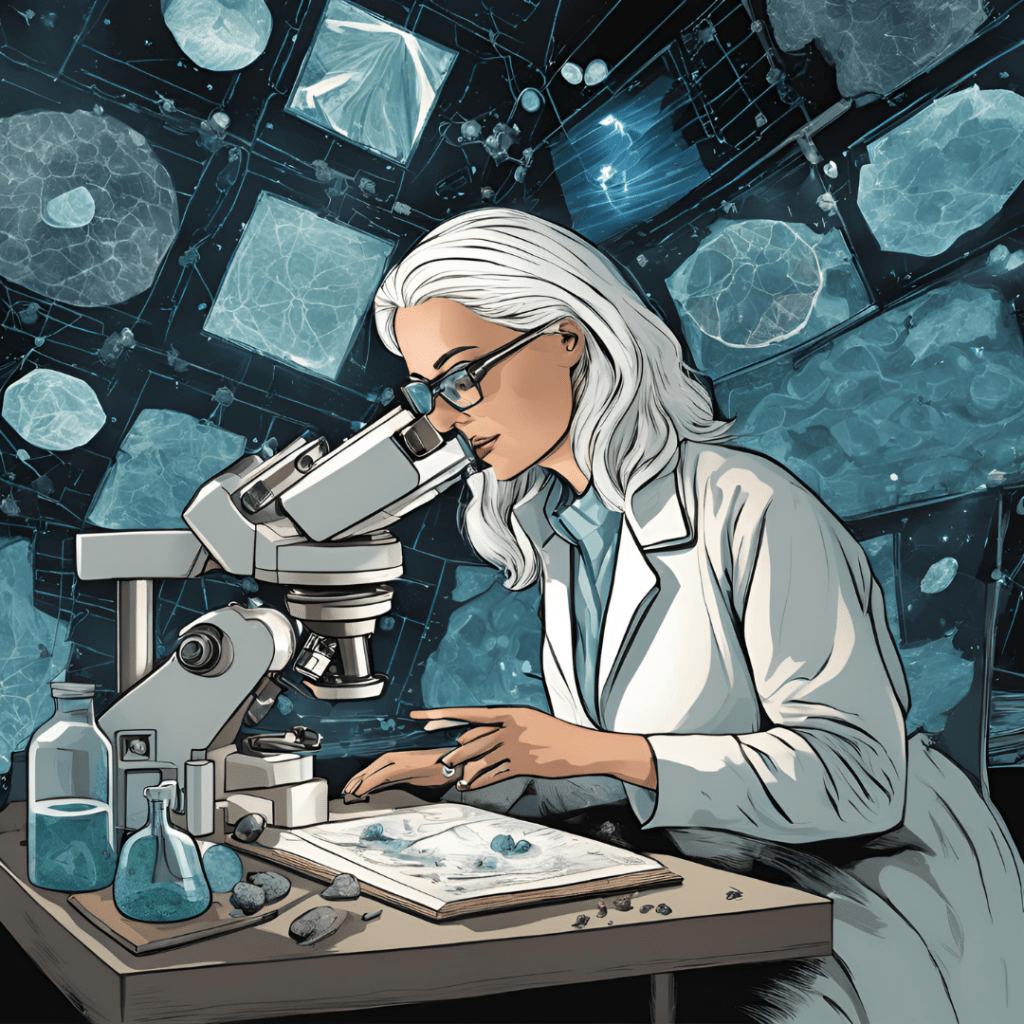
When she obtained the seed that her granddaughter Senna now possessed, she had planned to bring it to the Northern Triangle, where Sweden, Norway, Finland, Denmark, Germany, and Poland had united to create one protective territory and preservation. This was the seed that would immortalize all of the seeds they had collected. This was the seed that would save humankind, that would save Earth. Her journey to find it was arduous, mentally, physically, and spiritually taxing. Her journey back was just as painful and many times longer. She arrived home to her son and his wife who was ecstatically pregnant with Senna and utterly resentful that the ongoing war would take Everest away for another unknown length of time. Knowing that this measly little seed would bring her son home to his family forever made the nearly fatal expedition more than worth it. Excited to examine their last ray of hope, Kendra carefully slid the seed onto a tray and under the high-power microscope in her home lab. As the lens came into focus, Kendra knew.
There was no hope.
She could feel the denial, the disbelief, the disappointment, and then the rage, boil in her blood. Her hands twitched as her eyes stared blankly into the microscope lens. The microscope was top of its line, the sharpest lens any lab could procure, and yet everything was now a blur – out of focus, incomprehensible. In a matter of seconds she was ready to smash the seed with the heavy base of the microscope. It was a waste. It was all a waste. There is no hope left. As she lifted her head away from the microscope and began to remove the seed, her unpacked backpack flashed in the corner of her eye. She was still shaking when she ran to unzip the bag, her hands slowly steadying themselves as she reached in and retrieved a mahogany hardcover book. That night she spent reading every page a dozen times over, making neat annotations in the margins. Sheets of paper with drafts of diagrams and models penned out covered her desk. For the first time ever, Dr. Kendra Aozra had a desk that actually looked like it belonged to the mad scientist she was. When the sun rose the next morning, she looked at the piece of paper resting in front of her tired eyes. It was the final depiction of a discovery of a lifetime and it would save lives.
But, not now. Not theirs. It would not save her life. Or her son’s.
But it would save Senna’s.
Decades of frustrating research and long hours felt so short as Kendra held Senna’s hand and led her through the house and to the dock just a hundred yards away. The memories bled into one another, forming a story cohesive only to the one who lived it. There was no time to tell Senna anything more and worse, all the risk to tell her anything further at all. Senna would be in enough danger as it was and as Kendra pushed Senna onto the overcrowded starship, she wondered if this was the right decision at all. Maybe she was sending Senna to an agonizing doom rather than saving her as she thought she would be all these years.
Senna stood pinned against the rail of the starship by the hundreds of people stuffed onboard behind her. She refused to let go of her grandmother.
“Grandmother, get on! I’ll pull you up!” She yelled above the panics of everyone else. Kendra put her other hand on Senna’s and for a minute Senna thought she would let her. Instead, she squeezed Senna’s hand one last time, leaning over the two feet of gravel separating the ship from the dock, to kiss Senna’s forehead one last time. This time, a tear rolled down her cheek before she could stop it. This time, her voice shook.
“I’ll wait for you at home. I love you, my little sprout.”
The starship rumbled. The air around it became violent and hot. The voices of the passengers aboard were drowned out by the supersonic propellers. The starship glided into the dark, cloudy sky and in a matter of seconds, disappeared into the atmosphere above and Kendra watched the last ray of hope of humankind disappear with it.
 katra
katra 
Leave a comment